Premium Grocery Store Site Selection Criteria
What 7 Brands' Locations Reveal
By Caldwell Smith
Published November 13, 2026

By Caldwell Smith
Published November 13, 2026
Premium grocery store site selection criteria fall into three profiles: Whole Foods ($111,875 median 3 mile income), regional full-service chains (Harris Teeter, Wegmans, The Fresh Market, $95,388 to $109,006), and mainstream natural formats (Sprouts, Natural Grocers, Fresh Thyme, $80,901 to $101,305). Education separates Whole Foods from Sprouts (45.7% vs. 36.7%) even though both sit in trade areas of about 100,000 people.
Whole Foods, Sprouts, and The Fresh Market post their own site criteria, but none shows what their stores actually look like. This article uses Sites USA's merchant location data to compare 1,794 stores across seven premium grocers.
Sprouts is doing most of the expanding. Sprouts has added 116 stores since 2021 (up 32.2%), followed by Whole Foods (+50), The Fresh Market (+22), and Wegmans (+13), while Harris Teeter is flat and Fresh Thyme is down 5.
| Brand | 5 Year Change | 2026 Store Count | % Change |
|---|---|---|---|
| Sprouts | +116 | 476 | +32.2% |
| Whole Foods | +50 | 528 | +10.5% |
| The Fresh Market | +22 | 180 | +13.9% |
| Wegmans | +13 | 114 | +12.9% |
| Natural Grocers | +9 | 168 | +5.7% |
| Harris Teeter | 0 | 259 | 0.0% |
| Fresh Thyme | -5 | 69 | -6.8% |
| Total | +205 | 1,794 | +12.9% |
Source: Sites USA merchant data
The seven brands grew about 12.9% since 2021, and Sprouts, Whole Foods, and The Fresh Market account for 92% of the gain. Sprouts' latest annual report plans more than 40 openings in fiscal 2026, concentrated in California and Texas while building out Florida and the Mid-Atlantic.
Seeing where the opportunities exist is often more powerful than where the brands are strongest when it comes to site selection. REGIS Online's void analysis tool shows which brands are missing for any market, and the map below applies the same idea to all 50 states.
| Brand | Stores | States | Top three states |
|---|---|---|---|
| Whole Foods | 528 | 45 | CA 95, FL 37, TX 36 |
| Sprouts | 476 | 25 | CA 154, TX 60, FL 58 |
| Harris Teeter | 259 | 8 | NC 150, VA 53, SC 31 |
| The Fresh Market | 180 | 22 | FL 53, NC 21, VA 13 |
| Natural Grocers | 168 | 21 | CO 45, TX 24, OR 14 |
| Wegmans | 114 | 10 | NY 50, PA 19, VA 15 |
| Fresh Thyme | 69 | 10 | IN 15, OH 10, IL 9 |
Source: Sites USA merchant data
California (249 stores), North Carolina (198), Florida (149), and Texas (120) lead, and footprints are regional: about 98% of Harris Teeter's stores sit in five jurisdictions (NC, VA, SC, MD, and DC) and about 89% of Wegmans' in five states (NY, PA, VA, MD, and NJ).
The gaps matter more. Sprouts is absent from 26 jurisdictions, including Illinois, Ohio, Michigan, Minnesota, Wisconsin, Indiana, and Massachusetts, while Whole Foods is missing from only six (Alaska, Delaware, North Dakota, South Dakota, Vermont, and West Virginia). No state has more than five of the seven brands, and Illinois has 45 stores from three brands with no Sprouts. If you represent a center in a gap market, check the missing brand's profile in the next section first.
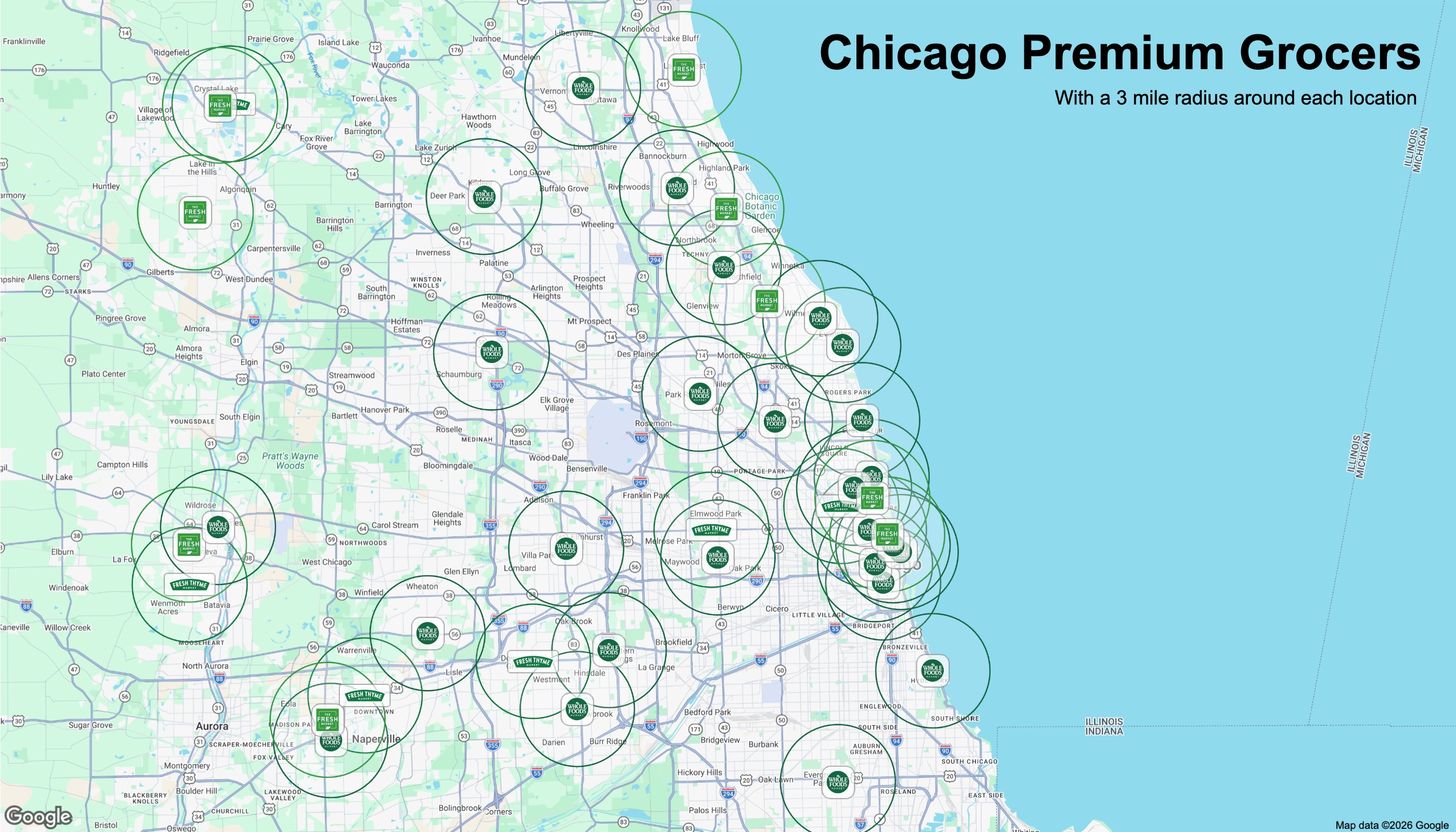
Looking at the data around existing locations tells several compelling stories about the different approaches each takes to their site selection strategy. This analysis uses a 3 mile radius and reports medians, because dense urban stores pull averages up (Whole Foods' average 3 mile population is 185,858, against a median of 106,495).
| Brand | Population | Income | Associate degree or higher | Stores in trade areas over $100K | Daytime ratio |
|---|---|---|---|---|---|
| Whole Foods | 106,495 | $111,875 | 45.7% | 64% | 1.10 |
| Harris Teeter | 55,697 | $109,006 | 44.7% | 59% | 0.89 |
| Sprouts | 96,315 | $101,305 | 36.7% | 51% | 0.87 |
| Wegmans | 59,430 | $100,801 | 40.9% | 51% | 0.99 |
| The Fresh Market | 64,157 | $95,388 | 42.7% | 41% | 1.06 |
| Fresh Thyme | 72,440 | $88,943 | 39.9% | 38% | 1.02 |
| Natural Grocers | 68,669 | $80,901 | 35.6% | 26% | 0.97 |
Source: Sites USA merchant data. AGS demographic data
Education stands out as one of Whole Foods' strongest trade area signals. In the median Whole Foods trade area, 45.7% of residents have an associate degree or higher, and 74% of stores are located in areas where at least 40% of residents meet that threshold. Whole Foods says as much on its real estate page, where its published guidelines ask for a “large number of college-educated residents” and typically 200,000 people within a 20-minute drive.
The rest of the profile fits: it has the highest daytime ratio of the seven (1.10), which points to employment-heavy locations, and its stores average 74,050 mobile visits per month.
Sprouts looks different. Its median trade area has a $101,305 income, 96,315 residents, 36.7% education, and the most residential profile of the seven (a daytime ratio of 0.87). Its stores average 45,057 mobile visits per month, and 51% sit in trade areas over $100,000.
Sprouts' site criteria list traffic counts of 40,000 vehicles per day, counting traffic traveling both directions at 69% of the stores that have both, that number is always close to or above that number.
Natural Grocers has the lowest income of the seven ($80,901) and 35.6% education, with 21% of stores in trade areas below $70,000, and its stores average 93,855 mobile visits per month. Fresh Thyme has an $88,943 median income and 39.9% education, averages 55,087 visits, and is the only brand that has shrunk since 2021 (down 5).
These three sit in smaller trade areas (55,697, 59,430, and 64,157 residents) with incomes of $109,006, $100,801, and $95,388. The Fresh Market's published criteria cite top-10% market incomes and strong residential and daytime population, and its stores bear that out, with 41% in trade areas over $100,000 and a daytime ratio of 1.06.
Visits separate these brands more than road traffic does: Harris Teeter and Wegmans draw about 108,000 per store per month, against 45,057 for Sprouts.
| Brand | Avg monthly visits per store | Avg ADT (vehicles per day) |
|---|---|---|
| Harris Teeter | 108,648 | 16,883 |
| Wegmans | 107,932 | 29,050 |
| Natural Grocers | 93,855 | 22,962 |
| The Fresh Market | 89,857 | 29,500 |
| Whole Foods | 74,050 | 23,382 |
| Fresh Thyme | 55,087 | 19,786 |
| Sprouts | 45,057 | 23,971 |
Whole Foods and Sprouts sit on nearly identical road traffic (23,382 and 23,971 vehicles per day), yet Whole Foods draws about 1.6 times the visits, and Harris Teeter draws 108,648 visits on roads averaging 16,883 vehicles, the lowest of the seven. Visits vary by market, so benchmark against your own: Whole Foods averages 59,183 in Los Angeles and 81,405 in Chicago, and Sprouts 37,744 in Los Angeles and 51,346 in Phoenix.
The co-tenant mix around each store furthers the story and reveals more of their strategy and who their target customers are. Starbucks is present at 72% to 94% of locations for all seven brands, so it doesn't separate them, but Dollar Tree does.
| Brand | Signature co-tenants (share of locations) |
|---|---|
| Whole Foods | Starbucks 94%, ChargePoint 76%, Chase Bank 76%, CVS 72%, UPS 71%, Tesla 52% |
| Harris Teeter | Starbucks 90%, UPS 57%, McDonald's 53%, Walgreens 51%, Truist Bank 50% |
| Sprouts | Starbucks 90%, McDonald's 72%, Subway 66%, CVS 64%, Chase Bank 62%, Dollar Tree 53% |
| Wegmans | Starbucks 72%, Dunkin' 65%, McDonald's 63%, CVS 62%, ChargePoint 60%, Dollar Tree 51% |
| The Fresh Market | Starbucks 88%, CVS 72%, Walgreens 64%, UPS 64%, Chase Bank 61%, Dunkin' 53% |
| Fresh Thyme | Starbucks 88%, McDonald's 71%, CVS 68%, Chipotle 67%, Great Clips 61%, ULTA 58%, Dollar Tree 57% |
| Natural Grocers | Starbucks 86%, McDonald's 76%, Subway 66%, Taco Bell 57%, Dollar Tree 57% |
Source: Sites USA merchant and co-tenant data
Dollar Tree is present at 31% of Whole Foods locations and 33% of Harris Teeter's, against 43% for The Fresh Market, 51% for Wegmans, 53% for Sprouts, and 57% for both Natural Grocers and Fresh Thyme. EV charging and premium services run the other way: ChargePoint is at 76% of Whole Foods locations against 32% of Harris Teeter's, and Tesla is at 52% against 34% for Sprouts. Dunkin' reflects region, not format.
Premium grocers don't share one site profile, and the data shows where they split.
For a broker or tenant rep, that makes the first step simple: pull the trade area, check it against these profiles, and see which of the seven aren't in the market yet.
REGIS Online puts the demographics, traffic counts, mobile visits, co-tenants, and void analysis for any site in one place, so you can see which of these grocers fit and which are missing from your market. To see it with your own sites, schedule a preview.
Last Modified November 13, 2026
What are Whole Foods' site selection requirements?
Whole Foods' published guidelines ask for a large number of college-educated residents and typically 200,000 people within a 20-minute drive. In the 3-mile trade areas around its stores, the median share of residents with an associate degree or higher is 45.7%, and 74% of stores sit where at least 40% hold that credential.
What are Sprouts' site selection requirements?
Sprouts' published criteria list traffic counts of 40,000 vehicles per day. The average of the two road counts at its stores is 23,971, and the two counts added together reach 40,000 at 69% of stores that have both. Its trade areas are the most residential of the seven brands, with a $101,305 median income.
How is Whole Foods' site selection different from Sprouts'?
Whole Foods sites in more educated, employment-heavy trade areas: 45.7% associate degree or higher and a 1.10 daytime ratio, against 36.7% and 0.87 for Sprouts, though both sit in trade areas of about 100,000 people. Whole Foods also draws about 1.6 times Sprouts' mobile visits (74,050 vs. 45,057) on nearly identical road traffic.
Which premium grocery chains are expanding?
Sprouts is expanding fastest, adding 116 stores since 2021 (+32.2%), followed by Whole Foods (+50), The Fresh Market (+22), and Wegmans (+13). Harris Teeter is flat and Fresh Thyme is down 5. Sprouts' annual report plans more than 40 openings in fiscal 2026.
What are the best co-tenants for a premium grocery store?
Starbucks is present at 72% to 94% of locations for all seven brands, so it doesn't separate them. Dollar Tree does: 31% of Whole Foods locations against 53% to 57% for Sprouts, Natural Grocers, and Fresh Thyme. ChargePoint EV charging is at 76% of Whole Foods locations against 32% of Harris Teeter's.
Which premium grocers are missing from my market?
Sprouts is absent from 26 jurisdictions, including Illinois, Ohio, Michigan, Minnesota, Wisconsin, Indiana, and Massachusetts, and Whole Foods is missing from six (Alaska, Delaware, North Dakota, South Dakota, Vermont, and West Virginia). The state map shows each brand's store count by state.